
Boosted Scopes
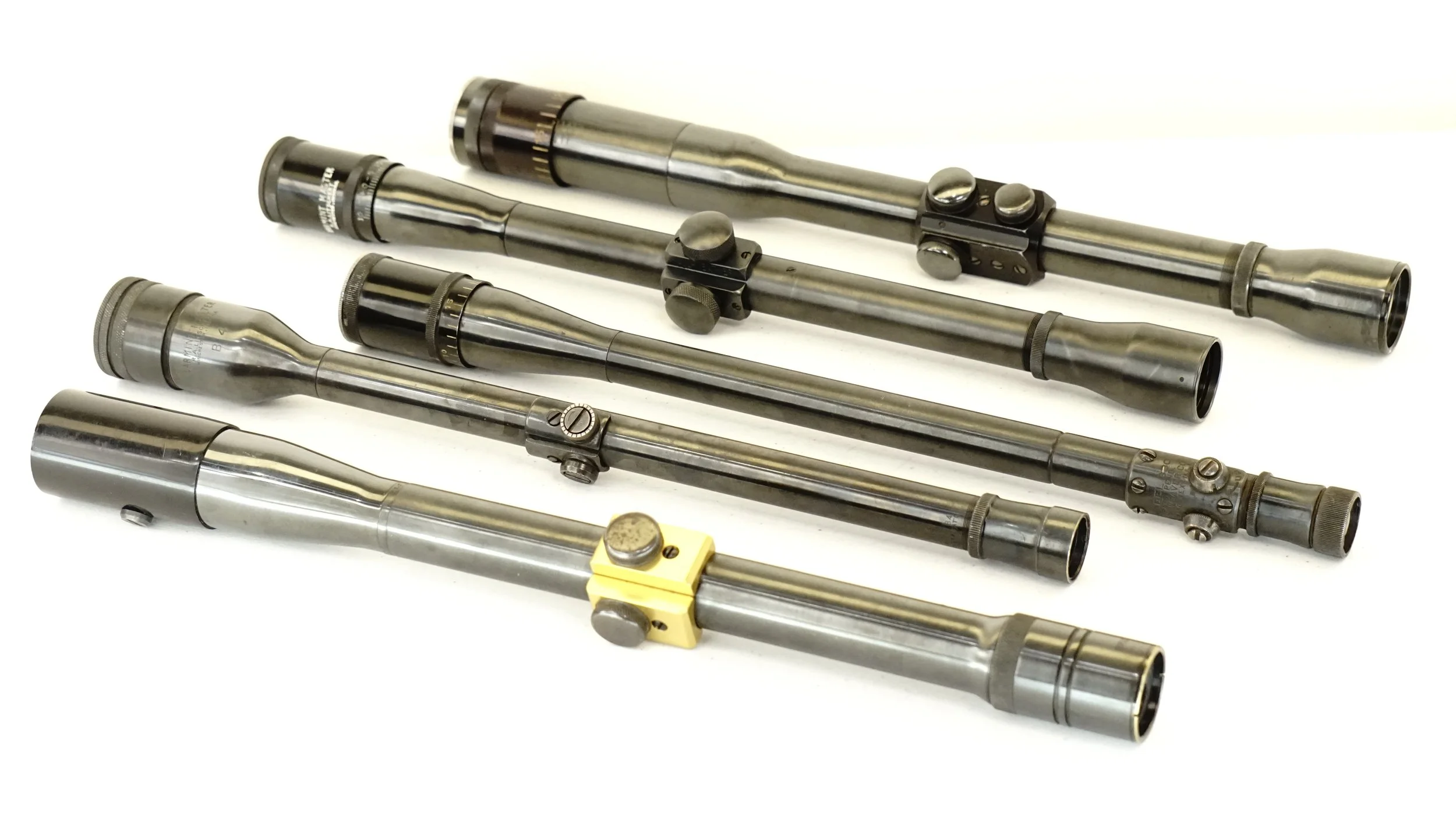
Boosters were made for a wide array of vintage scopes. Pictured above from top to bottom: Weaver KV, Lyman Alaskan, Weaver 330, Weaver B4 and JC Higgins.
Vintage Glass, Modern Power — The Litschert Booster and the High-Power Classic Scope
Ask most collectors about vintage riflescopes and the same names come up: the Lyman Alaskan, the Weaver K2.5, the Weaver K4. These are the scopes that rode on deer rifles and varmint guns from the 1940s through the 1960s, and they earned their reputation honestly. But they all share one trait that today's shooter tends to notice right away: they are low-power optics. A K2.5 gives you two-and-a-half power. A K4 gives you four. The Alaskan sits right in that same neighborhood. For woods hunting that was plenty. For a modern shooter who has grown up behind higher magnification, it can feel like looking through the wrong end of history.
What a lot of people don't realize is that shooters in that era wanted more reach too — and there was a clever answer for it. It was called a booster, and the best-known name in the game was R. A. Litschert.
Who Was Litschert?
R. A. Litschert of Winchester, Indiana, was marketing scope attachments as early as the mid-1930s. His idea was simple and, for the time, close to genius. Instead of asking the working man to buy an expensive high-power target scope, Litschert sold an accessory — a lens in a machined housing — that threaded onto the scope he already owned and multiplied its magnification. Overnight, an ordinary hunting scope became a target or high-power varmint optic, and at a fraction of the cost of a whole new scope.
Litschert offered several models over the years — the Spot-Shot, the Varmint-Master, and the Targeteer — built to fit the common 3/4", 7/8", and 1" scope tubes of the day. You'll often find the power stamped right on the aluminum lens cover: a 6, an 8, sometimes a 12. For a 1" scope like a Weaver K-series, the 6X and 8X boosters are the sweet spot — enough added magnification to genuinely change what the scope can do, without pushing past what the rest of the optic can support in the field.
How a Booster Actually Works
A Litschert booster is not a gimmick or a simple magnifying cap. It's an optical element that changes the effective focal length of the system. To run one properly, the original objective lens is removed from the scope and the booster takes over that end of the optical path. The result is a real increase in magnification — a 4X K4 stepping up to 8X, for example — rather than a cropped or degraded image.
That distinction matters. Because the booster is doing genuine optical work, a well-made, properly set-up boosted scope holds a clarity that surprises people who expect vintage glass to look dim and fuzzy. When the internals are right, an 8X boosted Weaver or Lyman Alaskan can be a joy to look through.
Where Modern Glass Changes Everything
Here's the part that brings the story into the present. Vintage boosters were paired with vintage glass, and glass from the 1940s and 50s — however charming — simply doesn't transmit light or resolve detail the way modern optical glass does. Push an old lens set to 8X and the shortcomings show: softness at the edges, a darker picture, less contrast.
At Vintage Gun Scopes, we rebuild these scopes with modern optical glass inside the original housings. That's the combination that makes a boosted scope truly shine. You keep the correct vintage exterior — the profile, the finish, the period-correct look that belongs on a classic rifle — but the image you see is bright, sharp, and high in contrast, edge to edge. Marry that rebuilt scope to a Litschert booster and you get something genuinely rare: a high-power vintage scope that performs. Correct on the outside, excellent on the inside.
Why Today's Shooter Should Care
A lot of modern shooters lean toward higher magnification. They're used to it, they like the precision it allows, and a 2.5X or 4X classic scope can feel limiting no matter how beautiful it is. A boosted scope answers that directly. It delivers the 6X or 8X that a varmint shooter, a precision plinker, or a target-minded hunter actually wants — while keeping the character, the history, and the correct look of a genuine vintage optic.
It also fills roles that a plain low-power classic can't. Prairie dogs and other small varmints at distance, small targets at the range, and any situation where you need to pick out fine detail all reward the extra magnification. And because these are period pieces, a boosted setup carries a uniqueness that no modern scope can copy. Very few people are shooting a genuine Weaver K4 with a factory-correct Litschert Varmint-Master booster and modern glass inside. It's a conversation piece that also happens to shoot.
A Little History Worth Preserving
Litschert retired in 1961 and sold the business to Myron Davis, who carried the quality forward under the Davis Optical name. That lineage is part of what makes these boosters collectible today — they represent a moment when American optical makers were solving real problems for everyday shooters with real ingenuity. Restoring one and putting it back to work is a way of keeping that story alive rather than leaving it in a drawer.
Bring a Classic Up to Power
If you love the look and feel of a vintage scope but want the magnification that modern shooting calls for, a boosted setup is the answer that's been hiding in plain sight for eighty years. Rebuilt with modern glass and paired with a genuine Litschert booster, a Weaver K4 or a Lyman Alaskan becomes a high-power classic that's both beautiful and capable.
Browse our remanufactured boosted scopes at vintagegunscopes.com, or reach out and tell us what rifle and application you have in mind — we'll help you build the right high-power vintage scope for the job.